Description
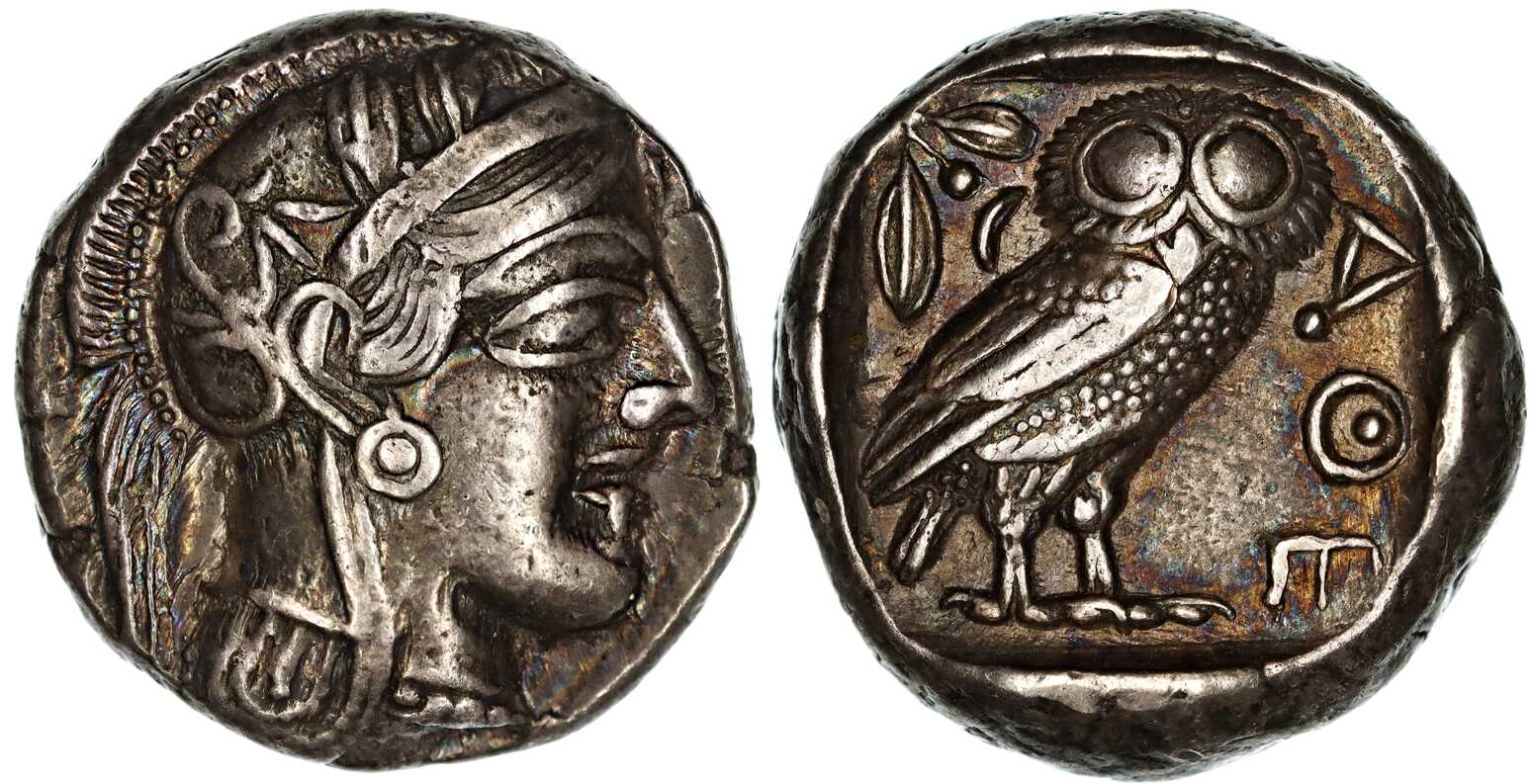
Attica, Athens, time of the ‘Delian’ League, Silver Tetradrachm (17.19g, 23mm, Attic standard), ‘Mass Classical’ (‘Athenian Imperial’) issue, circa 454-404 BC. Obverse: Head of Athena facing to the right, wearing crested Attic helmet ornamented with three olive leaves above visor and spiral palmette on bowl, round earring with central boss and pearl necklace; her hair flows in parallel lines. Reverse: Athenian Owl stands right, head turned facing forward, olive sprig and crescent to upper left, “AΘE” (‘AΘENAION’) downward to right; all within incuse square. Kroll-8; SNG Copenhagen-31. A lovely example of the ‘Mass Classical’ Athenian owl which saw immense production and pervasive circulation across the entirety of the Athenian Empire for the 50-year period, deeply toned and well centred showing much headdress, worn obverse die, Extremely Fine.
In the late 6th and early 5th Century BC, Athenian coins were struck in smaller, more artistic batches (known as the Archaic or Transitional phases) and are generally considered very rare on the numismatic market. This changed drastically in 454 BC when the Athenian statesman Pericles moved the sizeable treasury of the Delian League from the sacred island of Delos directly to the Athenian Acropolis, seizing the massive reserve of allied silver which was then melted down for use in striking Athenian ‘Imperial’ Tetradrachms. With this, Athens was able to fund immense civil projects such as the Parthenon and Propylaea, fund the daily wages of their immense maritime workforce, and later, toward the end of the 5th century BC, fund their army against Sparta during the Peloponnesian War. The design of the ‘Mass Classical’ Tetradrachm was kept the same as its predecessor Tetradrachms: the obverse featured a stylized, slightly archaic form of Athena wearing a crested Attic helmet, and the reverse an Athenian owl. This decision was made for logical reasons: merchants across the Ancient Greek world recognized the rigid, archaic look as a guarantee of high purity silver coinage immediately – any changes to this design may cause implicit distrust or suspicion of counterfeiting. With control of the Delian League as well as its treasury, the fifty years between 454 and 404 BC is commonly referred to as the ‘Athenian Imperial’ period, and Athenian dominance was only ended 404 BC when they were defeated by Sparta who then tore down the walls of Athens and plundered its treasury. Naturally, with no silver reserves the ‘Mass Classical’ owl’s production ended, and the Athenian coinage would cease production entirely for many decades, later returning in the 4th century BC with a more lifelike design.