Description
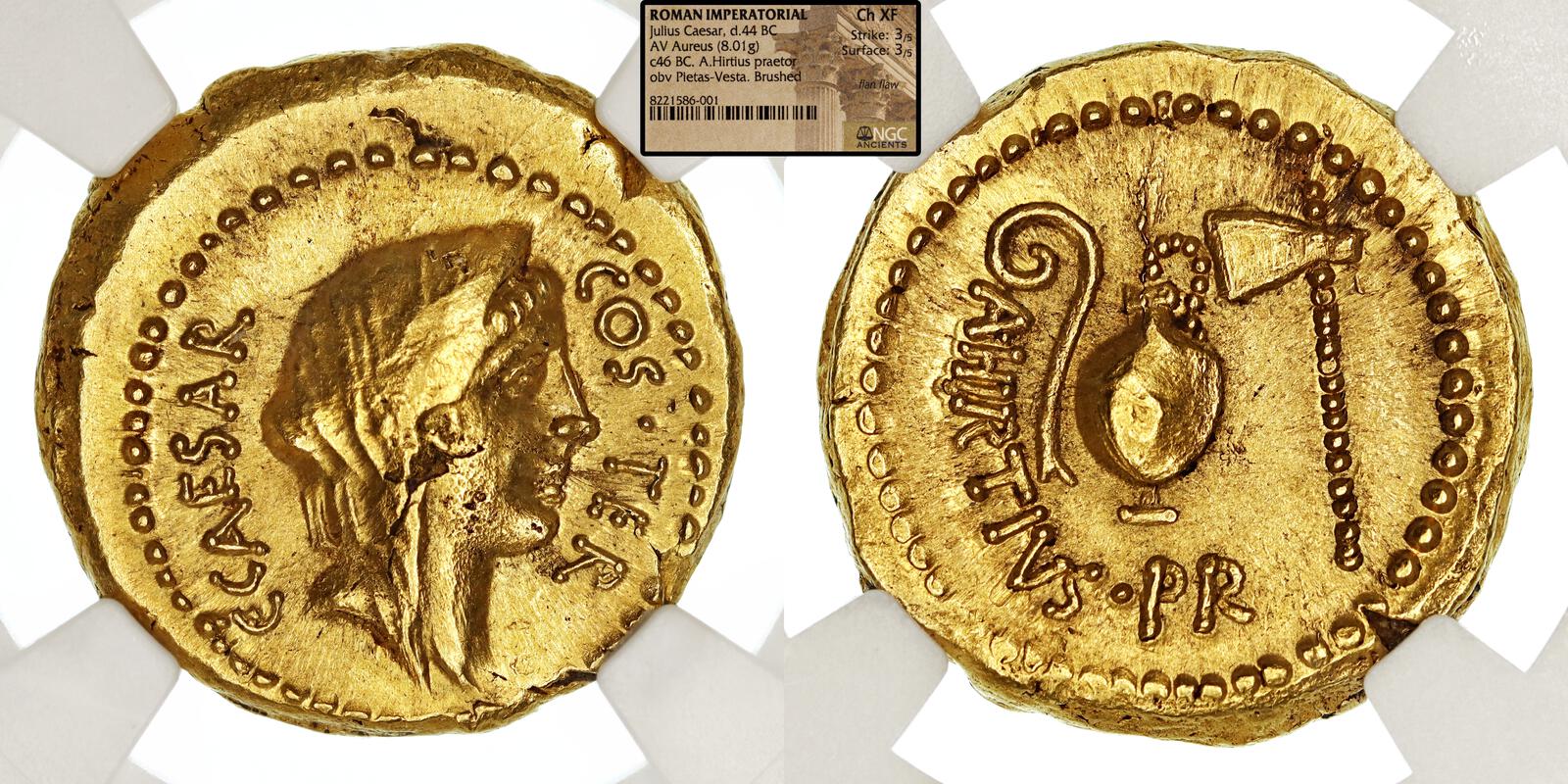
Roman Republic, the Imperatorial Period, Gāius Iūlius C.f. C.n. Caesar (Julius Caesar) of gens Iūliī Caesarēs, Roman Statesman and Military General of the Republic, as Dictātor 49-44 BC, with Aulus Hī̆rtius of gens Hī̆rtia, as Praetor, Gold Aureus, ‘Dōnātīvum’ issue in celebration of Caesar’s military triumphs in Gaul, Egypt, Pontus, and Africa, struck at Rome mint 46 BC. Obverse: Veiled head facing to the right, possibly of Julius Caesar as the Pontifex Maximus, in the guise of Vesta or Pietas, legend surrounds, “C· CAESAR COS · TER”. Reverse: Emblems of the Augurate and Pontificate, from left to right: lituus (Augur’s curved staff), capis (ritual jug), and securis (sacrificial axe), legend surrounds, “A· HIRTIVS · PR”. Crawford-466/1; Sydenham-1017; Calicó-37. Graded by NGC as Choice Extremely Fine (Strike 3/5; Surface 3/5); Flan Flaw. A minor flan flaw on the obverse is easily looked when appreciating the neat style of the obverse’s portrait, and the reverse is choice and near perfectly centred – a highly desirable coin.
The obverse Latin legend reads unabridged as “Gāius Caesar, consul tertium”, with an English translation of “Gaius Caesar, Consul for a third term”, this references Caesar’s third consulship of 46 BC with Mārcus Aemilius Lepidus, the first being in 59 BC with Mārcus Calpurnius Bibulus and the second in 48 BC Pūblius Servīlius Isauricus. The reverse Latin legend states the issuing authority and his rank, unabridged as “Aulus Hī̆rtius, Praetor”.
This Offered Aureus:
The presented numismatic piece is an exceptional insight into the history of the Roman Republic and the military general Gāius Iūlius Caesar, and was the first gold aureus to be produced by the Ancient Romans in large quantities as a circulating monetary piece, and likely a major point at which the aureus became a crucial part of the Roman monetary system. Struck by his Praetor, Aulus Hī̆rtius of gens Hī̆rtia, it was a triumphant issue designed to serve as, in conjunction with silver denarii, dōnātīvum (financial gratuity) for his legionaries in commemoration of the four major military victories between 58 and 46 BC. Not only did it commemorate triumph, this aureus may also be interpreted as a hopeful issue that Caesar had finally brought peace to the turbulent Roman Republic; the last of the four victories was in north Africa where the Caesarian legions defeated Metellus Scīpiō at the Battle of Thapsus – with this decisive Pompeian defeat many hoped that the long civil wars were finally over.
Military Gratuity
During the lavish triumphal processions of 46 BC, it is said that each legionary was awarded a lifetime’s worth of salary as military gratuity – more specifically, a 5000 denarii gratuity was given to each legionary, double for each centurion, and double again for each tribune and cavalry prefect. Not only incredibly generous, these dōnātīva were paid out of Caesar’s private war treasury rather than official state funds, which after the four major campaigns was said to be between 60,500 and 65,000 Attic talents of silver. To put this into perspective, an Attic talent was 6000 Attic Drachms (4.31g each) or approximately 25.86 kilograms, and Roman Republic Denarius, as set by Caesar himself, was struck to 3.9 grams – this means approximately 6000-6630 Denarii (traditional sources state 6000:1; literal weight based calculation 6630:1) could be struck for each Attic talent.
Peace
The second commemorative nature of this aureus, as mentioned previously, was of ‘Pāx’, specifically that the latest victory over the Pompeians, two years after Gnaeus Pompeius Magnus’ death, would finally bring an end to the Civil Wars and usher in a period of peace. This would prove to be a tragically ironic aspect of this issue, unfortunately, as although Caesar’s Civil War would end the following year after the Battle of Munda, further civil wars would begin after Caesar was assassinated on the Ides of March, the 15th of March, of 44 BC by senators led by Quīntus Servīlius Caepiō Brūtus and Gāius Cassius Longinus. Also, Aulus Hī̆rtius, the Praetor who had issued this coin, died only one year after Caesar on the 21st April 43 BC during the Battle of Mutina against the forces of Mārcus Antōnius – a seemingly contrived battle over post-Caesar control of Cisalpine Gaul and against a man who had been one of Caesar’s most trusted generals.
Who was Caesar?
Gāius Iūlius ‘Gāī fīlius’ ‘Gāī nepōs’ Caesar (Gaius Julius Caesar, son of Gaius, grandson of Gaius), was a member of gens – or family – Iūlia, specifically the family branch of gens Iūliī Caesarēs, one of the most prominent patrician families of Ancient Rome with ancestral ties to Roman mythology. Despite having a rich history of prominent statesmen as far back as the early 5th Century BC, beginning first with Gāius Iūlius Iūlus’ Consulship in 489 BC, the family’s most illustrious member is arguably the aforementioned, becoming one of the most influential and well-known men of the Roman Republic. The life and achievements of Gāius Iūlius Caesar is far out of the scope of this little write up and we employ you to read further – one of the more remembered parts of his tale was not of his life, but his death: the Dictātor was assassinated on the Ides of March, 15th of March, of 44 BC, by senators led by Quīntus Servīlius Caepiō Brūtus and Gāius Cassius Longinus, leading to a major civil war within the Roman Republic. In opposition to the Tyrannicides (‘tyrant killers’) was the Caesarian faction led by three men: Mārcus Antōnius, one of Caesar’s highly trusted generals, Gāius Iūlius Caesar ‘Octāvianus’, Caesar’s adopted son, and lastly Mārcus Aemilius Lepidus, a prominent statesman and who Caesar shared consulship with in 46 BC. These three came together to form the Second Triumvirate – an extraordinary magistracy that reasserted Caesarian control over the western provinces and consolidated power in preparation for war. At the start of 42 BC, the Triumvirs secured the deification of Caesar, declared by the Senate on the 1st January 1942, and he was thereafter known as Dīvus Gāius Iūlius C.f. C.n. Caesar (the Divine Gaius Julius Caesar, son of Gaius, grandson of Gaius).