Description
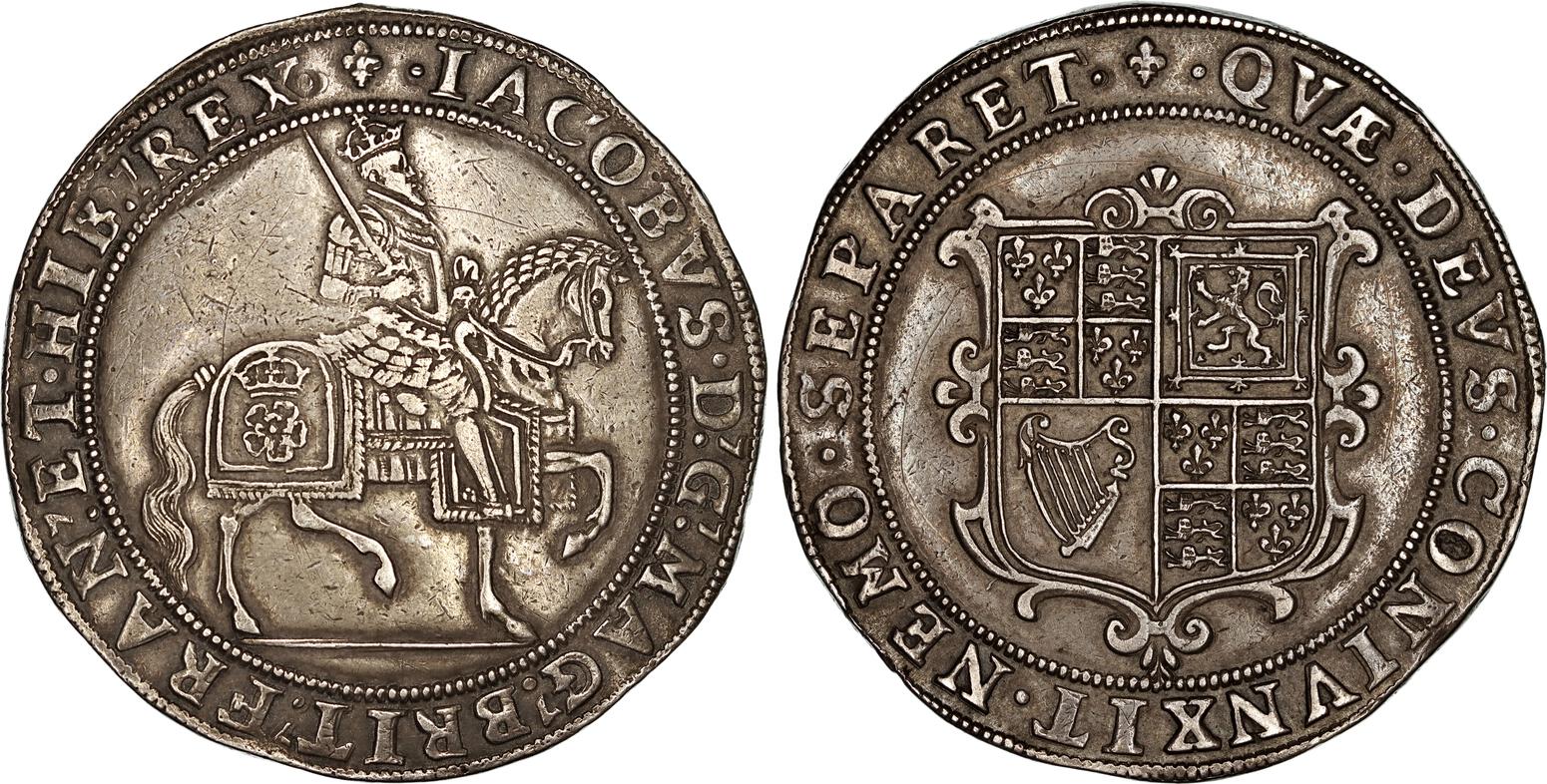
Kingdom of England, James VI & I of the Scottish House of Stuart, King of Scotland (from 1567, as James VI) and of England and Ireland (1603-1625 AD, as James I), Silver Crown (29.99g, 43mm), Second coinage (1604-1619), initial mark ‘Lis’ (1604-1605), Royal mint London. Obverse: King James I on horseback trotting right, crowned and wearing full armour, holds his sword aloft and resting on his shoulder in right hand and the reins in his left – his horse is heavily caparisoned with the crowned Tudor Rose displayed on its hind; ground-line below, inner beaded border and legend surrounds, “·IACOBVS· D:G: MAG: BRIT: FRAN: ET· HIB: REX·”. Reverse: Royal Arms of the unified Kingdoms of England, Scotland and Ireland set within decorative, scroll frame, inner beaded border and legend surrounds, “QVÆ· DEVS· CONIVNXIT· NEMO· SEPARET·”. North-2097; S-2652. A truly superb example of this notoriously weak issue, nicely toned with an even cabinet grey and evenly worn, some old hairlines to the reverse field, easily overlooked when appreciating the full horseman and the superb reverse strike, overall good Very Fine, reverse better, and quite scarce.
The obverse Latin legend is the royal titulature of King James VI & I, reading unabridged as “Iācōbus, Deī grātiā, Magnae Britanniae, Franciae et Hiberniae Rēx”, with an English translation of “James, by the Grace of God, King of Great Britain, France and Ireland”. The Reverse Latin legend is stated in full as “Quae Deus Coniūnxit Nēmō Sēparet”, with an English translation of “Which God united, no man may put asunder”. Both legends reference the King’s hopes and dreams for the unification of Scotland and England, notably by calling himself ‘Magnae Britanniae Rēx’ – ‘King of Great Britain’, as well as explicitly mentioning the unification on the reverse.