Description
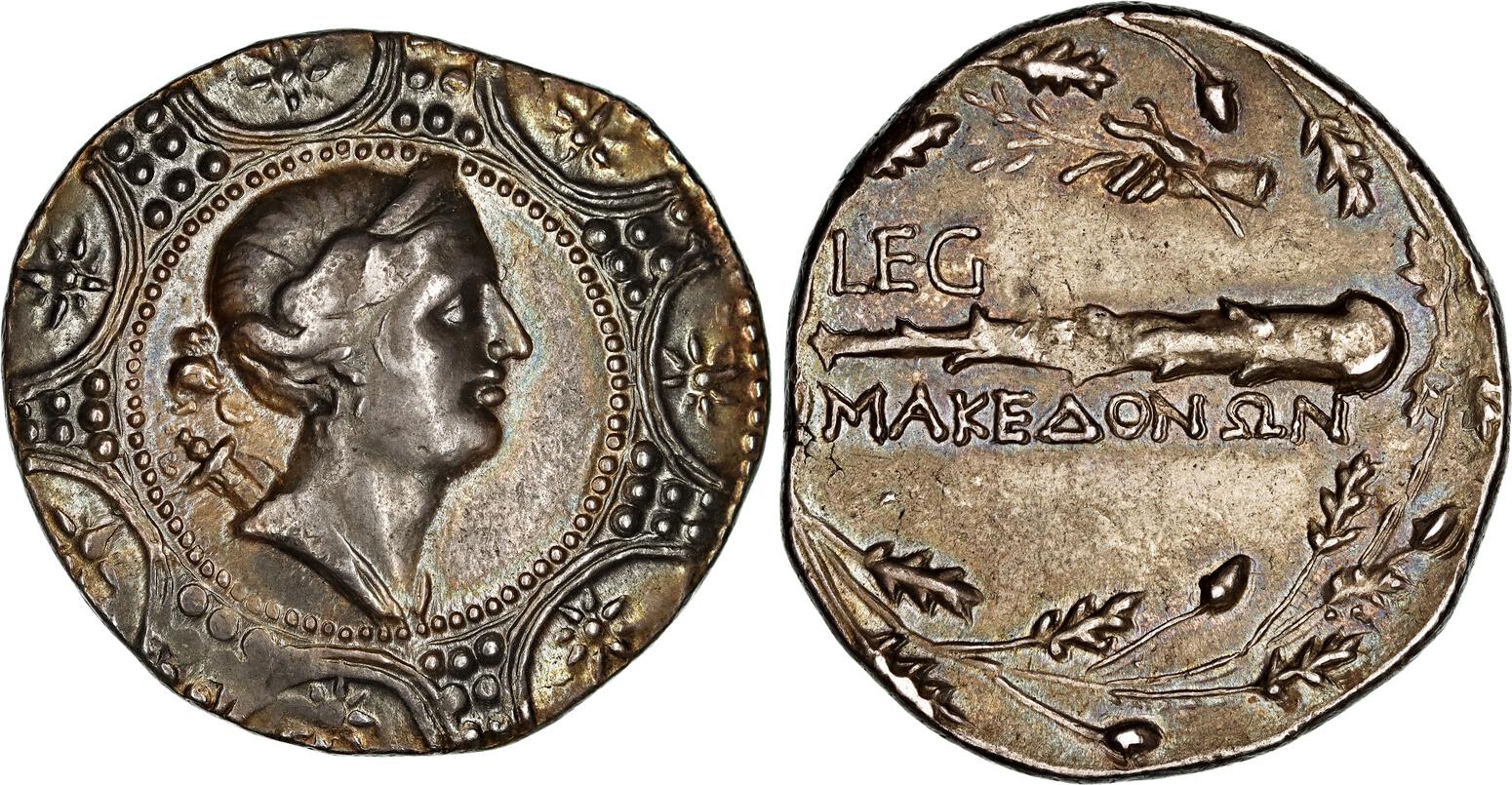
Roman Republic, Prōvincia Macedoniae (Province of Macedon), Silver Tetradrachm (16.75g, 29mm, Attic standard), ‘Lēgātiō Măkedónōn’ (Embassy of the Macedonians) – ‘Roman Embassy’ issue, Amphipolis or possibly Thessalonica mint circa 148–147 BC. Obverse: Diademed and draped bust of Artemis ‘Tauropólos’ (‘the Hunting-Bull Goddess’) facing right, quiver full of arrows and bow over her left shoulder, inner beaded border surrounds, all at the centre of a Macedonian round shield ornamented with stars within crescents around the periphery. Reverse: Club of Hēraklês horizontal at centre, legend in Latin and Greek to inner field, “LEG” above, “ΜΑΚΕΔΟΝΩΝ” below, hand holding olive branch to field above, all within wreath of oak. SNG Copenhagen-1317; SNG Lockett-1540; SNG Ashmolean-3310. The transition period between the Macedonian ‘Merídes’ and the Prōvincia Macedoniae between 148-147 BC – the “Roman Embassy” type, an exceptional and noteworthy offering and very rare, soft over portrait else supremely toned and visually appealing, Extremely Fine, quite rare.
After losing to the Roman Republic in the Third Macedonian War between 171 and 168 BC, the Kingdom of Macedon was not annexed as a Prōvincia, instead the Romans partitioned the Kingdom into four autonomous, puppet ‘Republics’ in order to dismantle centralized power of the Antigonid Dynasty and prevent future rebellions – essentially Macedon became a Roman Protectorate. This administration was known in Latin as the ‘Mācedonum Regiōnēs’ (‘Regions of the Macedonians’), and the first region, Mācedonum Prīma Regiō (‘the First Region of the Macedonians’), also known in Ancient Greek as Μακεδόνων πρώτη μερίς (‘Makedónōn prṓtē merís’), was centred on the wealthy city of Amphipolis as its capital. During this period, beautiful Tetradrachms were struck featuring the city’s Patron deity, Artemis ‘Tauropólos’ (‘the Hunting-Bull Goddess’), centred on a round Macedonian shield on the obverse and the Club of Hēraklês within wreath on the reverse with the inscription “ΜΑΚΕΔΟΝΩΝ ΠΡΩΤΗΣ” (‘Măkedónōn prṓtēs’). Numismatically speaking, these tetradrachms are catalogued under the ‘First Meris’ – I suggest that this is slightly inaccurate as it uses the Ancient Greek word ‘merís’ (‘region’), when in reality this was a Roman-made administration and the Latin name of ‘Prīma Regiō’ would be more appropriate.
In 150 BC, the Macedonians, led by the Antigonid-pretender Andrískos who had claimed himself Băsĭleús Makedónōn as King Philip VI, rebelled against the Roman Republic and prompted the Fourth Macedonian War – the last war to seriously threaten Roman control of Greece until the First Mithridatic War sixty years later. King Andriscus was initially successful, defeating the Romans and conquering much of Thessaly, but soon lost at Pydna in 148 BC against the Praetor Quīntus Caecilius Metellus, weakening the Macedonian position. After this defeat, Andriscus was betrayed to the Romans and the Macedonian territories were fully annexed, becoming Prōvincia Macedoniae. For his success in Macedon, Quīntus Caecilius Metellus was awarded the agnomen ‘Macedonicus’, roughly translating as ‘conqueror of the Macedonians’, and would go on to rise up the cursus honōrum, later serving as Cōnsul in 143 BC, the Prōcōnsul of Hispānia Citerior in 142 BC and Cēnsor in 131 BC.
The offered piece here, known numismatically as the ‘Roman Embassy’ issue due to its bilingual inscription “LEG ΜΑΚΕΔΟΝΩΝ”, transliterated as the Latin ‘Lēgātiō’ and the Ancient Greek ‘Măkedónōn’ (‘Embassy of the Macedonians’), is a tetradrachm that offers a fascinating insight into the transitionary period between when the Kingdom of Macedon was a Roman Protectorate and its full annexation.