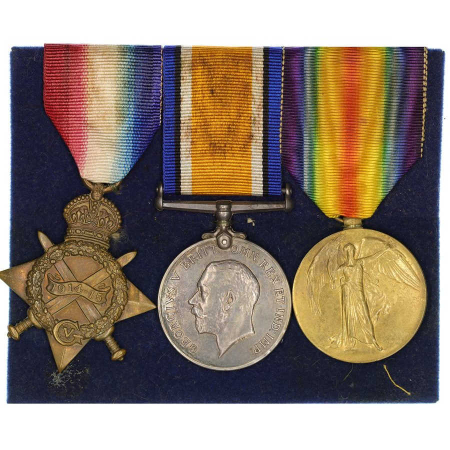

Description
Distinguished Conduct Medal, George V, edge impressed “2646 PTE D.A. KELL. 32/AUST: INF:”
A scarce gallantry award to the 32nd battalion – although not awarded for direct involvement in combat, the citation reads exceptionally well and the action itself was crucial in saving further Australian lives during the Second Battle of Villers-Bretonneux. Further, being a higher gallantry award, this piece is one of only 16 to the 32nd Battalion during WWI, making it very scarce and a great addition to any medal collection. Medal unmounted, lightly polished in the past and toned since, light marks, Extremely Fine.
The Distinguished Conduct Medal, promulgated by the London Gazette No. 30899, Third Supplement dated 3rd September 1918, and Commonwealth of Australia Gazette No. 15, dated 4th February 1919.
The original recommendation reads:
“At VAUX sur SOMME, near CORBIE, on the 24th April 1918, Pte D.A. KELL displayed conspicuous bravery and devotion to duty under very trying circumstances.
After two hours heavy gas shell bombardment, the enemy placed an H.E. barrage on and around the emergency position which the company was occupying. Regardless of his own personal safety, Pte KELL moved along the whole of the company bandaging wounded and assisting gas cases, despite heavy shell fire. The enemy then changed barrage from H.E. to H.E. shrapnel and it became necessary for the company to change its position to avoid further casualties. Pte KELL was sent from Company HQ’rs to Platoon Commanders with a message to this effect. To deliver this message, he had to pass through the wood, which was saturated with gas and heavily barraged with H.E. and shrapnel. On his way Pte KELL was seriously wounded causing him to be incapable of walking. Despite this, he crawled the remainder of the way to the nearest platoon commander and delivered his message, whereupon he lost consciousness. His gallantry and devotion to duty undoubtedly saved many casualties. By his conduct and self-sacrifice, Pte KELL showed a fine example to all ranks. His conduct and bravery have been brought under notice several times during the past fifteen months, during which time he has been employed as one of the company runners.”
The original citation reads:
“For conspicuous gallantry and devotion to duty. Private Kell displayed great gallantry and devotion to duty during trying circumstances, when the emergency position we were occupying was heavily bombarded by the enemy with gas and high explosive shells. With complete disregard for his own safety, Private Kell moved up and down the company, bandaging the wounded and attending to the gas cases, until it became necessary for the company to change its position to avoid further casualties from the shrapnel which the enemy was now using. Private Kell, being sent from company headquarters to the different platoon commanders, had to pass through on area saturated with gas, and heavily barraged with high-explosive shrapnel shell. On his way, he was seriously wounded, but managed to crawl to the nearest platoon commander; having delivered his message, he lost consciousness. By his self-sacrificing courage, Private Kell was the means of saving many casualties, and this example of his conduct is not an isolated instance of behaviour which has several times been brought to notice as deserving of the highest praise during the last fifteen months he has been employed as company “runner.”.”
Douglas Andrew Kell, born in March 1885 and raised in the city of Adelaide, South Australia, was a ‘Traveller’ (travelling salesman?) by trade and the husband of Mrs Violet Elizabeth Kell and the father of two children and had experience serving with the South Australian Rifles for two years. At the age of 30, Douglas attested for the Australian Imperial Forces at his local enlistment centre in Adelaide on 10th January 1916 and was posted to the fifth reinforcements to the 32nd Battalion and assigned Private 2646.
- Following training, he departed for overseas service 25th March 1916
- Continued on to France, disembarking on 30th June 1916, proceeded to join 32nd Battalion and officially T.O.S. 2nd August 1916
- Evacuated to Hospital in Norfolk, England due to Laryngitis, 3rd January 1917, returned to unit 14th November 1917
On 30th November 1917, Douglas was wounded in action with a gunshot wound to the right thigh and was evacuated to hospital, later returning to his unit on 22nd December 1917.
The ‘German Spring Offensive’ began in March 1918, a series of German attacks along the Western Front. At the time of the Second Battle of Villers-Bretonneux between the 24th and 27th April 1918, the 32nd Australian Infantry Battalion was positioned in the nearby town of Vaux-Sur-Somme – during the heavy German artillery offensive on the area, Douglas Andrew Kell displayed great gallantry and disregard for his own personal safety in his capacity as company runner, as described in his aforementioned recommendation and citation. He was quickly evacuated following the ordeal with reported gunshot wounds to his right shoulder, back and legs, and was admitted to the 1st Southern General Hospital in Stourbridge, England, where he stayed until being cleared in June 1918. Following this stay in hospital, Douglas remained in company depots in England for the remainder of his service.
Following the armistice and end of the war, Douglas returned to Australia, embarking from England on 15th January 1919 aboard H.M.T. ‘City of Exeter’ and arriving home on the 28th February, later discharging form the Australian Imperial Force on the 26th April with a total service 3 years 137 days, 2 years 341 days overseas. For his service, Douglas was also awarded the British War Medal and Victory Medal. It is of note that his gallantry award is one of only 16 Distinguished Conduct Medals awarded to the 32nd battalion for First World War.