
Description
Military Medal, George V, edge impressed “5713 PTE R.K. HUMPHRIS. 10/AUST: INF:”.
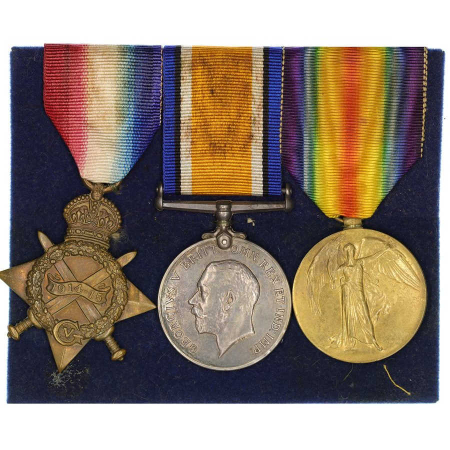
British War Medal, edge impressed “5713 T-SGT. R.K. HUMPHRIS. 10-BN. A.I.F.”
Victory Medal, edge impressed “5713 T-SGT. R.K. HUMPHRIS. 10 BN. A.I.F.”
With contemporary Military Medal Ribbon Bar, ‘Returned from Active Service badge’ [numbered 26897], first issue ‘Returned Soldier’s League badge’ [numbered 13287], and Gilt Enamelled Fob from the gifted by the community of Millicent, reverse engraved “SGT. R.K. HUMPHRIS M.M.”.
A really nice M.M. and Pair to a South Australian man who was clearly beloved by his community and who was from a large family that gave three sons to the First World War effort. Although there is no formal recommendation or citation due to the nature of an immediate awarding in the field, the firsthand recount (despite the possibilities of embellishment) from a letter to his wife quite vividly recounts the action and certainly justifies the award. Further, the strong evidence suggesting that the M.M. was granted by Sir William Birdwood, commander of the I ANZAC Corps, is certainly compelling. Trio is swing mounted in an old style with original silk ribbons and attached to cardboard square, virtually as issued.
The Military Medal, granted as an immediate award in the field, promulgated by the London Gazette No. 30135 dated 15 June 1917, and the Commonwealth of Australia Gazette No. 169 dated 4th October 1917. A recollection of the event survives in a contemporary letter from Mr Humphris to his wife, as outlined in an excerpt from the Daily Herald 1st October 1919:
“The platoon I belong to was called up hurriedly to the assistance of a platoon of another battalion in difficulties with the enemy, and we arrived just in time to drive the enemy off after sharp fighting. It was open warfare, and in consequence the troops dug in. Owing to the smallness of the trenches our platoon had to spread the boys over several small ones, and somehow, I alone got into a trench with a number of the platoon we assisted. After we had beat off the enemy, the officer found that we were out of ammunition, and called for volunteers, to go back about three- quarters of a mile to get some, and also for artillery assistance. Owing to a couple of his men having been knocked over by snipers just previous to our arrival, and because doubtless they were tired, none of his men volunteered. In the circumstances I resolved to go. I immediately jumped from the trench. I ran as fast as possible, frequently changing my course, lying down, crawling, etc., to dodge several snipers who were firing at me. Some of the bullets whistled close to my head, but, thank God, I dodged them, delivered the message, and got the ammunition up. The officer of the other battalion mentioned me in despatches, and, that won me the Military Medal.”
Richard Knott Humphris, born in Bordertown, South Australia on the 24th June 1875, was the second eldest son of Mr Henry Humphris and Mrs Sarah Humphris (nee James) and the brother to ten siblings. On 4th June 1902, Richard married Ms Elizabeth Holliff Burton Hotby and together raised two children, Ethel Winnifred Humphris and Harry Richard Humphris. As a young adult, he was employed by the South Australian Railway as the Station Master of the town of Millicent, and an active member of the community.
Likely owing to the current service of their youngest brother, Bryan Humphris, Private 531 of the 32nd Battalion A.I.F., who enlisted on 7th July 1915, Richard, now 40 years old, and his other younger brother, Cav Humphris, 35 years old, attested for the Australian Imperial Force to serve in the First World War. Richard enlisted at the recruitment centre in Mount Gambier on the 28th March 1916 and Cav enlisted at their local centre in Millicent two days later on the 30th March – although separated by some distance, it’s clear that the brothers made mention of each other and were assigned consecutive service numbers, Richard as Private 5713, and Cav as Private 5712, and both were posted to the eighteenth reinforcements to the 10th Australian Infantry Battalion.
“Mr R. K. Humphris, stationmaster, Millicent — We, the children of the Millicent school, wish to let you know how proud we feel of you for your bravery in offering to go to fight for King and Empire. We know how much you are giving up to fight for us, and we wish you to accept and use often this little gift of ours, as a small reminder of your days in Millicent, and of the children whom you have so often helped. We wish you a successful campaign, a happy result, and a safe return to Australia and the loved ones at home. On behalf of the Millicent school children, we are sincerely yours.”
- Both Richard and Cav embarked from Melbourne 27th June 1916 aboard S.S. ‘Barambah’
- Disembarked at Plymouth 25th August 1916, proceeded to 3rd Training Battalion for training
- Proceeded to France, disembarked at Etaples 20th November 1916
Whilst onboard ‘Barambah’, Richard and Cav’s younger brother was killed in Action on the 20th July 1916 during the 32nd Battalion’s operations in Fromelles; the attack was part of the 8th Brigade’s initial assault on the extreme left of the Australian front that was focused around a position known as the “Sugarloaf”. During this action the 32nd suffered 718 casualties – a third of the battalion’s total casualties for the entire war – which equalled “roughly 90 percent of its effective strength”.
The following year, from the 9th April to 16th May 1917, Allied troops attacked German defences near the French city of Arras on the Western Front – known as the Second Battle of Arras. Towards the end of this period was a second attempt at attacking Bullecourt, a city to the south east of Arras, an action the 10th Infantry battalion was involved. During this time, Richard’s platoon was quickly employed to assist another battalion on the front line – after relieving their position and much open warfare, a lack of ammunition became a major concern. With so many casualties within the other platoon, Richard volunteered in their place to travel back to headquarters to request for further assistance. Running through countless sniper fire and artillery, he reached his destination and delivered the message, a very necessary action for the Australians who would otherwise have been jeopardized without ammo – this act of gallantry was recognized and was the reason for the immediate awarding of the Military Medal, confirmed on the 15th May 1917. Richard was amongst 16 NCO’s and 4 officers from the 10th Battalion to be awarded gallantry for this battle and they were paraded on the 24th July 1917 at the Battalion Headquarters.
Of note: Richard’s service records state that his Military Medal was awarded by order of General Sir William R. Birdwood, who at the time of the Second Battle of Arras was commander of the I ANZAC Corps and was also present in a nearby Headquarters during the Second Attack on Bullecourt on the 3rd May 1917. Sources relay the fact that Sir Birdwood frequently presented medals and made mentions in dispatches to soldiers for bravery on the Western Front. It is a possibility that Richard’s message was delivered to the headquarters where General Sir Birdwood was positioned and he was recognized for his gallantry and awarded an immediate Military Medal, and therefore no official recommendation or citation was scribed. Further evidence is the single M.M. ribbon bar which would have been given to him at the time.
- Appointed Acting Lance-Corporal 30th May 1918
- On 11th August 1918 Richard was appointed driver (whilst maintaining rank of Acting L-Cpl) in place of Private 612 John James Allen who returned to Australia for transport duty on the same day
- Appointed Lance-Corporal 22nd September 1918
- Appointed Temporary Sergeant 22nd December 1918
Following the end of the war, Richard returned home aboard H.M.T. ‘Ormonde’, embarking on the 16th June 1919 and arriving in Australia on the 27th July, later discharging from the Australian Imperial Force on the 13th September 1919. He returned to civilian life and to his role as Station Master, but instead of the Millicent station he was given charge of the Two Wells office. Richard Knott Humphris later passed away on 31st October 1952 at the age of 77 years, predeceasing his wife who passed in 1956. The other serving brother, Cav Humphris, passed away at the young age of 49 on 8th March 1930.