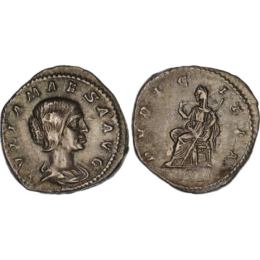
![SICILY, SYRACUSE. Hieronymus, 10 Litrai, 215-214 BC [AGC2-118] - Image 2](https://colonialcoins.com.au/wp-content/uploads/2026/10/AGC2-118-1.jpg)
Description
Sicily, Syracuse, Hĭerṓnŭmos (Hieronymus), Tyrant of Syracuse 215-214 BC, Silver Ten Litrai (8.48g, 22mm, Attic standard), circa 215-214 BC. Obverse: Head of Hieronymus facing to the left, wearing diadem (royal tainia), retrograde “K” to right field. Reverse: Winged Thunderbolt horizontal, “KI” above, legend above and below, “ΒΑΣΙΛΕΟΣ ΙΕΠΩΝΥΜΟΥ”. SNG ANS-1029; HGC 2, 1567. A rather attractive issue of the ephemeral Syracusan Tyrant Hieronymus, the obverse rather lustrous when held in hand, good Extremely Fine, reverse Extremely Fine.
The reverse Ancient Greek legend states the name of the Tyrant and is stated in full as “BAΣIΛEΩΣ ΙΕΠΩΝΥΜΟΥ”, in lowercase as “βασιλέως Ῐ̔ερώνῠμος”, transliterated as “Băsĭléōs Hĭerṓnŭmos”, with an English translation of “King Hieronymus”.
Ἱερώνυμος, Latinized as Hĭerṓnŭmos (from ‘hĭerós’ and ‘ónŭmă’, literally “having a holy name”), succeeded his grandfather, Hiérōn II, and became the Tyrant of Syracuse in 215 BC at 15 years old during a tumultuous period in Sicilian history – the Second Punic War between the Carthaginian Empire and the Roman Republic. At the time, Syracuse was an ally of Rome but its loyalty was wavering; the recent Battle of Cannae that resulted in an annihilation of Roman forces by Hannibal created a large support base within Syracuse to ally with Carthage over what they thought was a ‘Roman Republic destined to perish’. Convinced by his pro-Carthaginian uncle, Hĭerṓnŭmos abandoned the Roman alliance and engaged the Carthaginians to negotiate treaties. The Syracusan Tyrant’s ambitions were foolhardy, however, aggressively claiming sovereignty over the entirety of Sicily and mobilizing his forces to defend against what he expected would be a massive military response from Rome. Financing a quickly raised army resulted in a new 10 Litrai coin, the piece offered here, that served as a propaganda piece; Hĭerṓnŭmos is portrayed with a royal tainia, a diadem symbolizing his sovereignty, as well as a symbol of divine strength – Zeus’ winged thunderbolt, both of which signalled to Rome and Carthage that Syracuse was no longer a submissive client state. These ambitions were short-lived, however, as only 13 months into his reign, whilst occupying Leontini with a force of 15,000, a group of pro-Roman and anti-tyrannical conspirators within his entourage assassinated Hĭerṓnŭmos. News of the sovereign’s death reached Syracuse and chaos swept the city, resulting in two major changes: a royal purge began, killing most of the royal family including the late tyrant’s uncles, and control of the city shifted – Hippocrates and Epydides, the two brothers sent as Hannibal’s envoys, gained control of the city through political manipulation and assumed the position of supreme military commanders, locking Syracuse firmly into its alliance with Carthage. Roman response came thereafter, the Republic sending the famed general Mārcus Claudius Mārcellus who laid siege to Syracuse across 213-212 BC, and by 211 BC, the remaining holds of the city surrendered completely. Syraucse was brutally plundered, its immense treasures shipped back to Rome, and its centuries of independence as a proud Greek city-state were permanently brought to an end.